
Whey isolate vs concentrate: what is the difference, and is isolate worth it?
· 7 min read
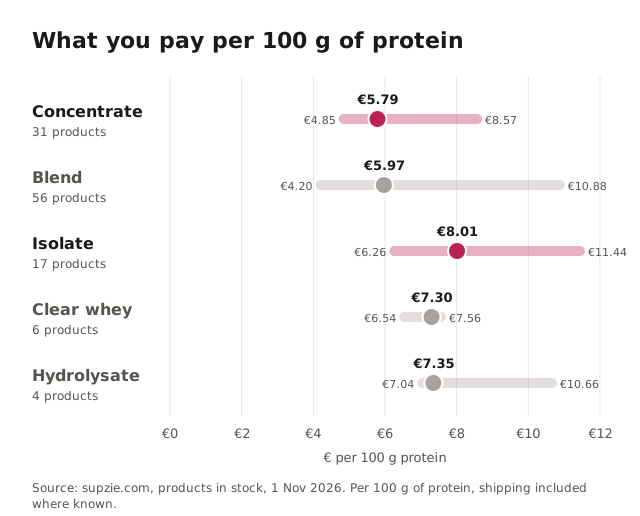
Whey isolate is whey concentrate that has been filtered further. It holds more protein per scoop and almost no lactose or fat. The protein itself is the same quality. On Supzie today (1 Nov 2026), a typical isolate costs €8.01 per 100 g of protein and a typical concentrate €5.79. So you pay about 38% more per gram of protein, mostly for the missing lactose. If lactose bothers you, that can be money well spent. If it doesn't, it buys you very little.
We compare prices, not health. Below is what the research says, what the labels say, and what each type costs on our whey price comparison per 100 g of protein.
What is the difference between whey concentrate and isolate?
Whey is the liquid left over when milk is made into cheese. Dry it, filter out water, lactose and minerals, and you have whey concentrate. Filter harder, removing most of the remaining lactose and fat, and you have whey isolate.1
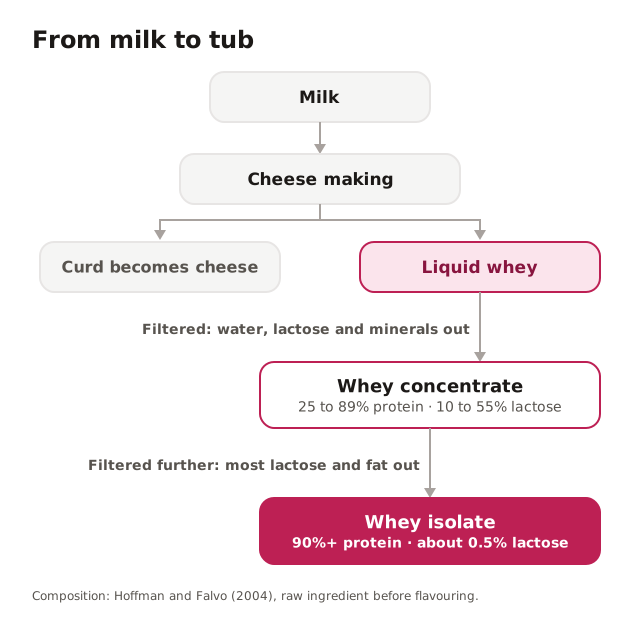
How far the filtering goes shows in the composition. These are the typical ranges for the raw ingredient, before flavour or sweetener is added:
| Per 100 g of ingredient | Whey concentrate | Whey isolate |
|---|---|---|
| Protein | 25 to 89 g | 90 g or more |
| Lactose | 10 to 55 g | about 0.5 g |
| Fat | 2 to 10 g | about 0.5 g |
Source: Hoffman and Falvo.1 A wider review puts concentrate at about 34 to 89% protein and isolate at 90% or more.2 "Concentrate" covers a wide range. "Isolate" is a narrow one.
Is isolate better protein?
Not as protein. A study that measured how well the amino acids of eight proteins are digested found both whey types at the top, above skimmed milk powder, pea, soya and wheat. Both had the same first limiting amino acid.3 Same protein, different amount of everything else.
The ISSN protein position stand notes that whey hydrolysates and isolates are the most researched proteins around training.4 That tells you what researchers tend to buy, since a purer powder is easier to dose. It does not show that concentrate works less.
The EU agrees in its own way. The claim "Protein contributes to a growth in muscle mass" may go on any food that is at least a source of protein.5 Concentrate and isolate get exactly the same sentence.
Lactose: the one difference that can matter
This is where isolate earns its price, for some people. Using the ranges above, a 30 g scoop of concentrate at the low end of 10% lactose holds about 3 g of lactose. The same scoop of isolate holds about 0.15 g. Twenty times less.
How much is too much differs per person. EFSA concluded that most people with lactose maldigestion tolerate as much as 12 g of lactose in one go with no or minor symptoms, and that some react to less than 6 g.6 The Voedingscentrum gives 10 to 15 g as an average.7 So many people who avoid milk can handle a scoop of concentrate. Others notice it. Your gut gets the deciding vote.
Check the label yourself. In the EU, "of which sugars" counts every mono- and disaccharide, and lactose is one.8 On an unflavoured whey, that line is mostly lactose. On a flavoured one, added sugar muddies it.
Milk allergy is a different thing. Lactose intolerance is about milk sugar. A milk allergy is an immune reaction to milk protein, and whey isolate is still milk protein.7 By law, every whey tub lists milk as an allergen.8 If you have a milk allergy, isolate is not the workaround. Talk to your doctor first.
What the labels say: 74 g against 86 g
We read 178 whey labels for Supzie. Flavoured and finished, the powder in the tub is less pure than the raw ingredient in the table above.
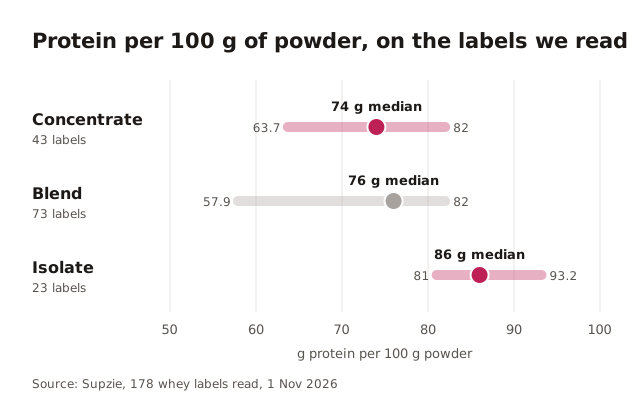
The median concentrate holds 74 g of protein per 100 g of powder. The median isolate holds 86 g. That gap is why we rank every whey by the price of 100 g of protein, not 100 g of powder. A cheap tub with 64 g of protein is not as cheap as it looks.
The "isolate" on the front of the tub
Of the 147 whey products on Supzie today, 65 are blends of concentrate and isolate. That is more than the pure concentrates (31) and pure isolates (18) together. A blend is a fine product. The catch is the label. Of the 62 blend labels where we have the full ingredient list, exactly one says how much of the whey is concentrate and how much is isolate. If "isolate" is the reason you pick a tub, check the ingredient list for the order and any percentages.
Two other types sit on the same shelf. Hydrolysate is whey that is partly broken down already, sold as faster to digest. Clear whey is an isolate made to mix into a clear, juice-like drink. Both cost more per 100 g of protein than a typical concentrate today. A third shelf neighbour, whey mixed with milk protein, is the cheapest per 100 g of protein on Supzie today, from €3.44. It is not pure whey, so it stays out of the comparison below, but you may see it at the top of our live price table.
What whey costs per 100 g of protein
| Type, in stock on Supzie (1 Nov 2026) | Products | Lowest | Median | Highest |
|---|---|---|---|---|
| Concentrate | 31 | €4.85 | €5.79 | €8.57 |
| Blend of concentrate and isolate | 56 | €4.20 | €5.97 | €10.88 |
| Isolate | 17 | €6.26 | €8.01 | €11.44 |
| Clear whey | 6 | €6.54 | €7.30 | €7.56 |
| Hydrolysate | 4 | €7.04 | €7.35 | €10.66 |
All prices are per 100 g of protein, from the label of each flavour. Where a shop tells us the shipping cost, it is included.
In euros per shake of 25 g of protein, the median concentrate costs €1.45 and the median isolate €2.00. One shake a day for a year makes about €200 difference.
The ranges overlap, though. The lowest isolate today, XXL Nutrition Whey Isolaat Vanille 1000 g at €6.26, costs less per 100 g of protein than 9 of the 31 concentrates. The lowest concentrate is Vitakruid Whey Protein Vanille 900 g at €4.85. The lowest blend is Mutant Whey Chocolate Fudge Brownie 2270 g at €4.20. So the type tells you less about the price than the shop and the tub size do.
Prices come from the shops' listings and update daily, and the shop's own price always wins. Compare every whey per 100 g of protein, filter by type, or read how we rank offers.
| Product | Per 100 g protein | Shop |
|---|---|---|
| Applied Nutrition Critical Whey Karamel latte 2000 gSupspace | €3.44 | Supspace |
| Applied Nutrition Critical Whey Bananenmilkshake 2000 gSupspace | €3.44 | Supspace |
| Applied Nutrition Critical Whey Vanille matcha 2000 gSupspace | €3.44 | Supspace |
| Applied Nutrition Critical Whey Witte choco-pistache 2000 gSupspace | €3.44 | Supspace |
| Applied Nutrition Critical Whey Frappuccino 2000 gSupspace | €3.44 | Supspace |
Prices as of 31 Oct 2026, 13:31.
How to choose between whey concentrate and isolate
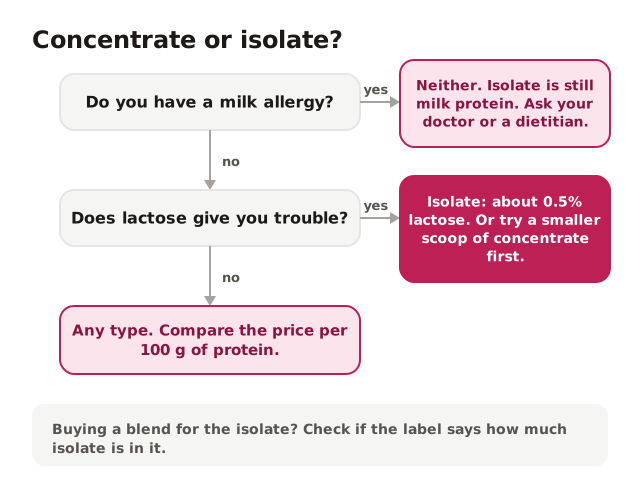
- Lactose gives you trouble? Isolate is where the extra money does something. Or try a smaller scoop of concentrate first and see.
- No trouble with lactose? Compare price per 100 g of protein across all types. The cheapest protein is often a concentrate or a blend.
- Picking a blend for the isolate? Check whether the label says how much isolate it holds. Usually it does not.
- Milk allergy? Neither type. Ask your doctor or a dietitian.
Further reading
- StrengthLog on whey concentrate vs isolate, a coach's evidence-based take with 17 references.
- The NHS page on lactose intolerance, on symptoms and when to see a GP.
- Examine.com on whey protein, for the wider research on whey.
- Stichting Voedselallergie on milk (in Dutch), the Dutch patient organisation on milk allergy versus lactose intolerance.
Written by the Supzie editorial team. We read 178 whey labels so the price per 100 g of protein means something.
Sources
-
Hoffman JR, Falvo MJ. Protein: which is best? Journal of Sports Science and Medicine. 2004;3(3):118-130. https://pmc.ncbi.nlm.nih.gov/articles/PMC3905294/ ↩
-
Minj S, Anand S. Whey proteins and its derivatives: bioactivity, functionality, and current applications. Dairy. 2020;1(3):233-258. https://doi.org/10.3390/dairy1030016 ↩
-
Mathai JK, Liu Y, Stein HH. Values for digestible indispensable amino acid scores (DIAAS) for some dairy and plant proteins may better describe protein quality than values calculated using the concept for protein digestibility-corrected amino acid scores (PDCAAS). British Journal of Nutrition. 2017;117(4):490-499. https://doi.org/10.1017/S0007114517000125 ↩
-
Jäger R, Kerksick CM, Campbell BI, et al. International Society of Sports Nutrition position stand: protein and exercise. Journal of the International Society of Sports Nutrition. 2017;14:20. https://doi.org/10.1186/s12970-017-0177-8 ↩
-
Commission Regulation (EU) No 432/2012 of 16 May 2012 establishing a list of permitted health claims made on foods, as amended. https://eur-lex.europa.eu/eli/reg/2012/432/oj ↩
-
EFSA Panel on Dietetic Products, Nutrition and Allergies (NDA). Scientific opinion on lactose thresholds in lactose intolerance and galactosaemia. EFSA Journal. 2010;8(9):1777. https://doi.org/10.2903/j.efsa.2010.1777 ↩
-
Voedingscentrum. Lactose-intolerantie. https://www.voedingscentrum.nl/encyclopedie/lactose-intolerantie.aspx ↩
-
Regulation (EU) No 1169/2011 of 25 October 2011 on the provision of food information to consumers, Annex I (definition of sugars) and Annex II (milk and products thereof, including lactose). https://eur-lex.europa.eu/eli/reg/2011/1169/oj ↩