
Flavoured creatine and whey: what does the flavour really cost you?
· 8 min read
Does flavour add calories to your creatine or whey? Barely. Unflavoured creatine has 0 kcal on the label, and a flavoured scoop adds a handful at most. Flavoured whey costs 2 to 11 extra kcal per 25 g of protein in the pairs we compared. What flavour really costs is creatine, protein and money. On the labels we read, a flavoured creatine scoop is typically 85% creatine, and as little as 68%. And the same tub from the same brand costs 6% to 66% more per 100 g of creatine once it tastes of something.
We compare prices, not health. Below are the labels, the sums, and what the words on the tub mean. All creatine prices are per 100 g of creatine on our creatine price comparison.
Does creatine have calories?
Not on the label. Unflavoured creatine monohydrate lists 0 kcal and 0 g of sugar. The EU's list of energy factors, which every nutrition label uses, covers protein, fat, carbohydrate, fibre, alcohol and a few others.1 Creatine is not on it.
Flavoured creatine adds something to the scoop. Usually that is citric acid, flavouring and a sweetener, sometimes a filler and a colour. The flavoured labels we checked for this article list no energy at all. So do the worst-case sum: even if all 1.6 g of extras in the biggest flavoured scoop counted as carbohydrate, at 4 kcal per gram, you would get under 7 kcal.1 For fasting or for calorie counting, that is a rounding error.
What else is in a scoop of flavoured creatine?
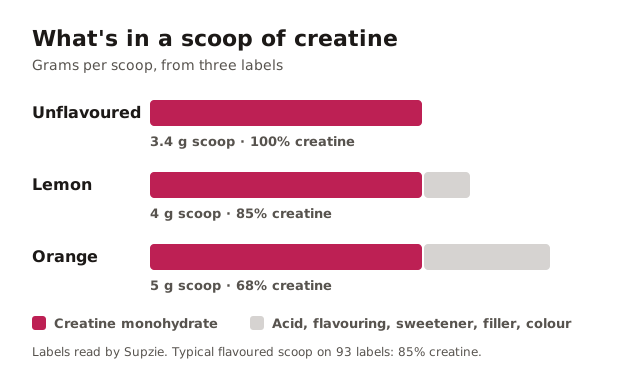
We have read 396 creatine labels for Supzie. On the 199 unflavoured powders, the scoop is in effect all creatine. On the 93 flavoured ones, the typical scoop is 85% creatine. The lowest is 68%.
Two real examples. A lemon creatine: 4 g scoop, 3.4 g of creatine monohydrate, plus citric acid, flavouring and sucralose. An orange creatine: 5 g scoop, the same 3.4 g of creatine, plus flavourings, citric acid, polydextrose as a filler, colours, sucralose and salt. Same creatine. A bigger scoop to carry the taste.
That is not a problem for your body. It is a problem for the price per gram, because the tub is priced per gram of powder and you are buying creatine.
Unflavored vs flavored creatine: the price
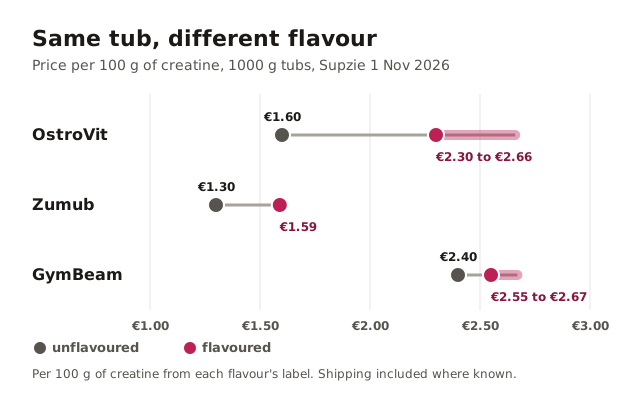
Across all creatine powders on Supzie, flavoured and unflavoured cost about the same per 100 g of creatine in the middle of the market. That is because plain tubs also include pricier brands and small packs. The fair test is the same brand, the same tub size, with and without flavour.
| Same brand, 1000 g tub, on Supzie (1 Nov 2026) | Unflavoured | Flavoured | Difference |
|---|---|---|---|
| OstroVit Creatine Monohydrate | €1.60 | €2.30 to €2.66 | +44% to +66% |
| Zumub Creatine | €1.30 | €1.59 (watermelon) | +22% |
| GymBeam 100% Creatine Monohydrate | €2.40 | €2.55 to €2.67 | +6% to +11% |
All prices per 100 g of creatine, from the label of each flavour. Shipping included where the shop tells us what it costs.
Lemon is a flavour. In the first row it is also a 44% surcharge.
| Product | Per 100 g creatine | Shop |
|---|---|---|
| Firm Foods Creatine 1000 gZumub | €1.00 | Zumub |
| Firm Foods Creatine 500 gZumub | €1.20 | Zumub |
| BulkLab Nutrition 100% Creatine Monohydraat Micronized 1000 gBulkLab Nutrition | €1.20 | BulkLab Nutrition |
| Zumub Creatine 1000 gZumub | €1.30 | Zumub |
| Zumub Creatine 500 gZumub | €1.40 | Zumub |
Prices as of 6 Nov 2026, 13:58.
Does flavoured whey have more calories?
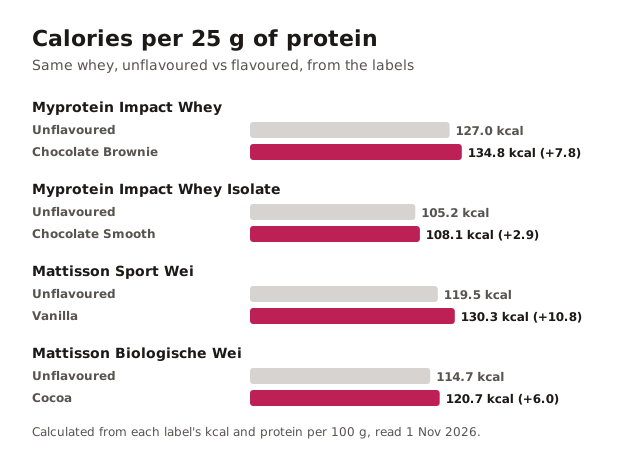
A little, per gram of protein. Not per scoop. We compared four pairs, the same product with and without flavour, using each label's nutrition table.
| Product (label, per 100 g) | Unflavoured | Flavoured | kcal per 25 g protein |
|---|---|---|---|
| Myprotein Impact Whey | 381 kcal, 75 g protein | Chocolate Brownie: 372 kcal, 69 g protein | 127.0 vs 134.8 |
| Myprotein Impact Whey Isolate | 362 kcal, 86 g protein | Chocolate Smooth: 359 kcal, 83 g protein | 105.2 vs 108.1 |
| Mattisson Sport Wei | 392 kcal, 82 g protein | Vanilla: 404 kcal, 77.5 g protein | 119.5 vs 130.3 |
| Mattisson Biologische Wei | 367 kcal, 80 g protein | Cocoa: 362 kcal, 75 g protein | 114.7 vs 120.7 |
Here is the twist. Per 100 g of powder, three of the four flavoured versions have fewer calories than the plain one. Flavour does not pile on calories. It takes the place of some protein, so you need more powder for the same 25 g. That extra powder brings the extra calories: 2 to 11 kcal per 25 g of protein in these pairs.
And it costs more. On Supzie today (1 Nov 2026), 100 g of protein from Myprotein Impact Whey costs €5.43 in the unflavoured 2.7 kg tub and €5.90 for Chocolate Brownie in the same size, on our whey price comparison.
What it adds up to over a year
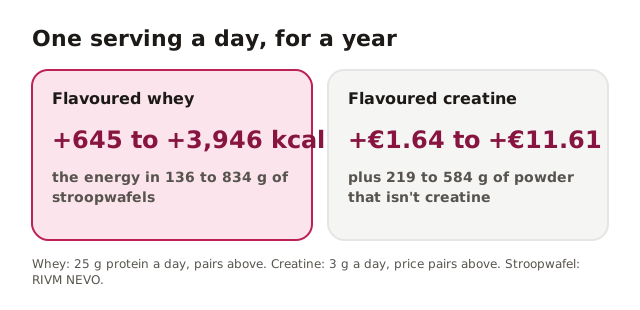
Whey, one shake of 25 g protein a day. The flavoured versions above add 645 to 3,946 kcal a year. That is the energy in 136 to 834 g of stroopwafels, by Dutch food data.2 Real, but small, at 2 to 11 kcal a day.
Creatine, 3 g a day. That is 1,095 g of creatine a year. At the price gaps above, flavour adds €1.64 to €11.61 a year. And with one scoop a day, you also buy 219 to 584 g of acid, flavouring, sweetener and filler.
So the calorie worry is mostly unfounded. The money and the dose are where flavour actually shows up.
Natural vs artificial: what the words on the tub mean
"Natural flavouring." In the EU this means something specific. A flavour may only be called natural if its flavouring parts are entirely of natural origin. If the label names the source, as in "natural vanilla flavouring", at least 95% has to come from vanilla.3
"Flavouring" or "aroma" on its own can be any flavouring the EU has authorised, natural or not. The label doesn't have to say which.
Sweeteners such as sucralose (E955) and steviol glycosides from stevia (E960) are food additives in EU law. They may only be used after a safety evaluation by EFSA.4 Stevia sounds more natural. Legally, both are E-numbers with a safety limit.
EFSA re-evaluated sucralose in 2026. It found sucralose safe for its current uses, with an acceptable daily intake of 15 mg per kg of body weight. It could not confirm safety at prolonged high temperatures, because chlorinated compounds may form, and it asked the European Commission to look into home baking and frying too.5 If you bake protein pancakes with a sucralose-sweetened whey, that is the part of this article worth remembering.
Sweeteners and weight. The WHO advises against using non-sugar sweeteners for weight control. That includes sucralose and stevia. The advice is conditional, and it does not apply to people with diabetes.6
Colours. Some flavoured creatine is coloured. Six colours carry a warning by EU law: "may have an adverse effect on activity and attention in children."7 One of them, E129, is in one of the orange creatines we read. If you see that line on a tub, that is why.
"Natural" does not mean fewer calories either. The vanilla whey with natural flavouring and stevia above adds the most calories per 25 g of protein in our pairs, simply because it holds the least protein.
How to choose
- Unflavoured creatine mixes into juice, yoghurt or your shake. You lose nothing but the taste and keep the dose and the euros.
- If you love a flavour, compare per 100 g of creatine or per 100 g of protein, never per tub. That is the number we rank by.
- Check the scoop. If it is bigger than the dose of creatine on the label, the difference is flavour.
- Bake with plain powder, or with one sweetened with something other than sucralose, if you want to stay out of EFSA's open question.
Compare every creatine per 100 g of creatine or every whey per 100 g of protein. For more on whey types, read whey isolate vs concentrate. For creatine, start with our complete guide to creatine.
Further reading
- StrengthLog's creatine guide, including how creatine dissolves and why it's fine if it doesn't fully.
- Examine.com on creatine, for the research behind the dose.
- Voedingscentrum on sweeteners (in Dutch), the Dutch nutrition centre's plain take on safety and E-numbers.
- We Love Cycling on reading a protein powder label (in Dutch), a calm guide to sweeteners and additives.
Written by the Supzie editorial team. We read 396 creatine labels and the nutrition tables of every whey pair above.
Sources
-
Regulation (EU) No 1169/2011 of 25 October 2011 on the provision of food information to consumers, Annex XIV (conversion factors for energy). https://eur-lex.europa.eu/eli/reg/2011/1169/oj ↩
-
RIVM. NEVO-online, Dutch food composition database: wafel stroop- gem (713), 473 kcal per 100 g. Consulted 1 Nov 2026. https://nevo-online.rivm.nl/ ↩
-
Regulation (EC) No 1334/2008 of 16 December 2008 on flavourings and certain food ingredients with flavouring properties, recital 26 and Article 16. https://eur-lex.europa.eu/eli/reg/2008/1334/oj ↩
-
European Food Safety Authority. Sweeteners (topic page). https://www.efsa.europa.eu/en/topics/topic/sweeteners ↩
-
European Food Safety Authority. EFSA finds sucralose safe when used as currently authorised; cannot confirm safety of extending its use. 17 February 2026. https://www.efsa.europa.eu/en/news/efsa-finds-sucralose-safe-when-used-currently-authorised-cannot-confirm-safety-extending-its ↩
-
World Health Organization. WHO advises not to use non-sugar sweeteners for weight control in newly released guideline. 15 May 2023. https://www.who.int/news/item/15-05-2023-who-advises-not-to-use-non-sugar-sweeteners-for-weight-control-in-newly-released-guideline ↩
-
Regulation (EC) No 1333/2008 of 16 December 2008 on food additives, Annex V. https://eur-lex.europa.eu/eli/reg/2008/1333/oj ↩