
How much whey protein per day? Do the math, not the scoop
· 8 min read
How much whey protein per day? Exactly as much as fills the gap between your daily protein target and the protein you already eat. For many people that gap is zero. Yet 126 of the 178 whey labels we read suggest the same 30 g scoop, about 23 g of protein, whether you weigh 55 kg or 100 kg. The research works per kilo of body weight: about 0.83 g as the general reference, and 1.4 to 2.0 g in studies of people who train. The rest is arithmetic, and we do it below.
We compare prices, not health. When we mention an amount, it is what the research used, with the source next to it. Whey prices per 100 g of protein are on our whey price comparison.
The 30 g scoop is a label default, not a dose
A scoop has to be some size, and 30 g is the industry habit. On the labels we read, one serving holds 23 g of protein on average (the median, ranging from 16 to 30 g).
Put that scoop next to people of different weights and it means very different things.
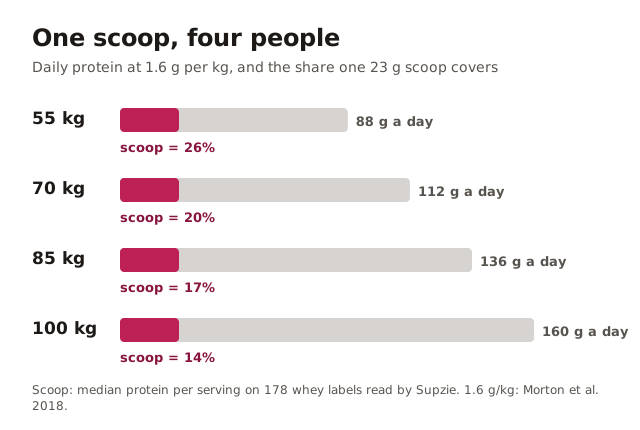
Same scoop. For one person it is a quarter of the day. For another it is a seventh. The scoop on the label tells you how the brand fills a tub, not what you need.
Does everybody need whey protein?
No. The Voedingscentrum says most people in the Netherlands get enough protein from their normal diet, and that this includes athletes and vegetarians.1 The ISSN, a sports nutrition society that is not shy about supplements, agrees that people who train can get their protein from whole foods. It calls supplements a practical way to do it, especially with fewer calories.2
So whey is a convenience, not a requirement. Convenience can be worth paying for. It is just not worth paying for twice, which is what happens when the shake comes on top of a day that already had enough.
1 or 2 g of protein per kg: what is research, what is marketing
The numbers come from real research. Where they get stretched is the marketing.
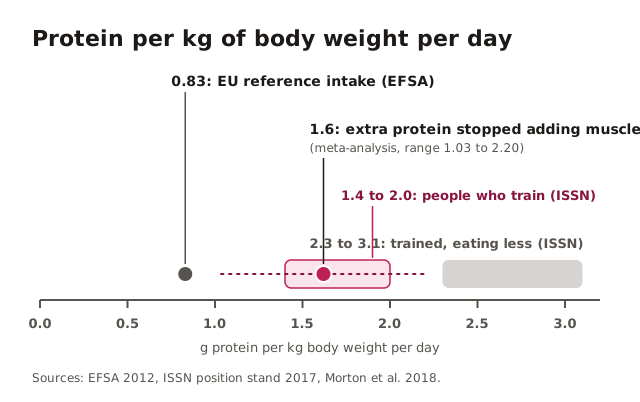
0.83 g per kg is the reference intake EFSA set for adults. It covers the needs of nearly all healthy adults, whatever their age.3 The Voedingscentrum uses the same figure.1
1.4 to 2.0 g per kg is the range the ISSN calls sufficient for most people who exercise and want to build or keep muscle.2 During a calorie deficit, it mentions 2.3 to 3.1 g per kg for trained people trying to hold on to muscle.
About 1.6 g per kg is where a meta-analysis of 49 studies with 1,863 people saw extra protein stop adding muscle in people doing strength training. The uncertainty around that point runs from 1.03 to 2.20 g per kg.4 So "2 g per kg" is not wrong. It is the top of the honest range, and it gets sold as the floor.
The marketing part is "more is better". In that meta-analysis it was not, past the plateau.4 Protein above your target is just calories, and a fairly expensive kind.
Is more protein safe? For healthy adults, EFSA considers intakes up to twice the reference intake safe, since active people in Europe regularly eat that much from normal food.3 Kidney disease is different. Dutch GP and internist guidance advises people with chronic kidney disease to avoid more than 1.3 g per kg of ideal body weight.5 If that is you, or you are pregnant, under 18 or over 70 and frail, the doctor or dietitian goes first.
One more caveat. If you carry a lot of body fat, multiplying by your full weight overshoots. Some calculators, StrengthLog's among them, use a lower range for that reason.
Can you get enough protein from food?
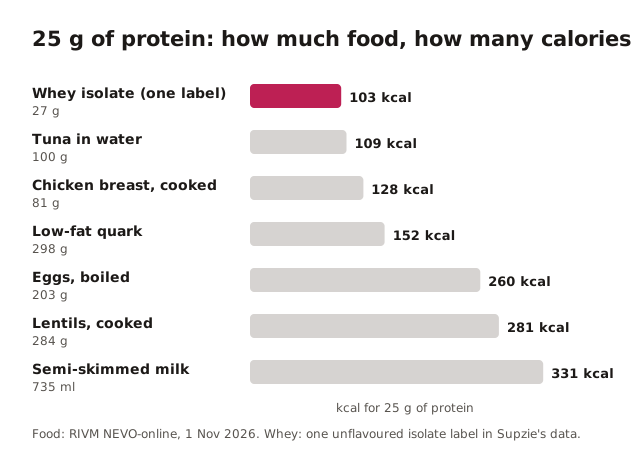
Yes, and for most people that is the default. Here is what 25 g of protein takes in everyday foods, with Dutch food composition data from RIVM.6
| 25 g of protein from | Amount | Calories |
|---|---|---|
| Tuna in water, tinned | 100 g | 109 kcal |
| Chicken breast, cooked | 81 g | 128 kcal |
| Low-fat quark | 298 g | 152 kcal |
| Eggs, boiled | 203 g (about 4) | 260 kcal |
| Lentils, cooked | 284 g | 281 kcal |
| Semi-skimmed milk | 735 ml | 331 kcal |
| Whey isolate, unflavoured (one label) | 27 g | 103 kcal |
Food values from NEVO.6 The whey row is one label in our data: an unflavoured isolate with 96 kcal per 23.3 g of protein. A concentrate adds a few more calories, because it keeps more lactose and fat.
Food brings things a shake does not: fibre in the lentils, a meal you actually chew. That is why food comes first in this article, and why the shake comes second.
When whey is an effective option
Protein delivers 4 kcal per gram. That is the factor every EU nutrition label uses.7 So 25 g of protein is at least 100 kcal, whatever the source. The question is how much comes along with it.
Whey brings very little extra. That makes it useful in three situations:
- You are eating fewer calories but want your protein high, the situation where the ISSN describes higher intakes.2 25 g of protein for about 100 kcal leaves room for everything else.
- Your appetite or your day gets in the way. Some people just can't face a third chicken breast.
- You don't eat meat or fish and find it hard to reach a higher target with lentils and dairy alone.
And the price. On Supzie today (1 Nov 2026), 25 g of protein from the median whey concentrate costs €1.45. From the median isolate it costs €2.00. We don't price food, so we can't put chicken next to it. We can say a shake you don't need costs the same as one you do.
A simple formula for your whey intake
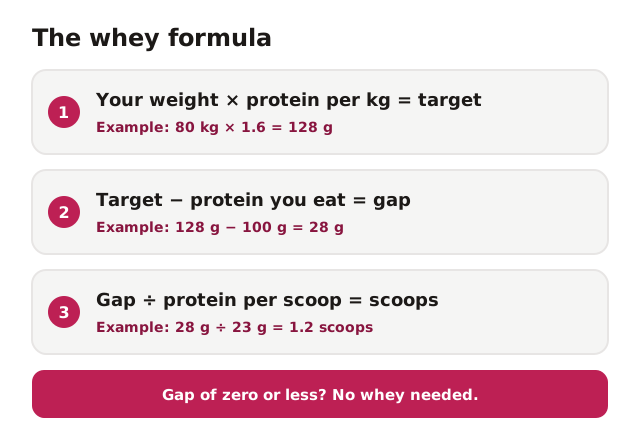
1. Your target range. Multiply your weight by the range that matches the people in the research: 0.83 g per kg as the general reference, or 1.4 to 2.0 g per kg if you train for strength.32
2. What you already eat. Log three normal days in a food app or with the labels, and take the average protein.
3. The gap. Target minus food. If the result is zero or less, you are done. No whey needed.
4. The scoops. Divide the gap by the protein per scoop on your own tub's label, not the 30 g on the front.
Example 1. You weigh 80 kg and lift weights. At 1.6 g per kg your target is 128 g. You eat 100 g. The gap is 28 g. With a scoop of 23 g, that is about 1.2 scoops. One scoop and an extra yoghurt does it. At €5.79 per 100 g of protein, those 28 g cost €1.62 a day, about €49 a month.
Example 2. You weigh 65 kg and run. At 1.4 g per kg your target is 91 g. You eat 95 g. The gap is below zero. The tub can stay in the shop.
Per serving. The ISSN describes 0.25 g of protein per kg of body weight per serving, or 20 to 40 g, spread every 3 to 4 hours.2 For 80 kg that is 20 g per serving. So a bigger scoop is not better, and two smaller servings spread over the day fit the research better than one big one.
In one line: (weight × g per kg) − protein from food = gap. Gap ÷ protein per scoop = scoops.
| Product | Per 100 g protein | Shop |
|---|---|---|
| Applied Nutrition Critical Whey Karamel latte 2000 gSupspace | €3.44 | Supspace |
| Applied Nutrition Critical Whey Bananenmilkshake 2000 gSupspace | €3.44 | Supspace |
| Applied Nutrition Critical Whey Vanille matcha 2000 gSupspace | €3.44 | Supspace |
| Applied Nutrition Critical Whey Witte choco-pistache 2000 gSupspace | €3.44 | Supspace |
| Applied Nutrition Critical Whey Frappuccino 2000 gSupspace | €3.44 | Supspace |
Prices as of 1 Nov 2026, 06:31.
Once you know your scoops, the only number left is the price per 100 g of protein. That is the one we do for you: compare every whey per 100 g of protein. And if you are choosing a type, read whey isolate vs concentrate first.
Further reading
- StrengthLog's protein calculator, which does step 1 for you, with separate ranges for building muscle, losing fat and higher body fat.
- Stronger by Science on protein, a long read by Greg Nuckols arguing the 1.6 g figure may be on the low side.
- Nieren.nl on eating and drinking with kidney disease (in Dutch), from the Dutch Kidney Foundation and the kidney patients' association.
- MAX Vandaag: protein shakes, yes or no? (in Dutch), with nutrition professor Jaap Seidell.
Written by the Supzie editorial team. We read 178 whey labels, so we know what is in a scoop.
Sources
-
Voedingscentrum. Eiwitten. https://www.voedingscentrum.nl/encyclopedie/eiwitten.aspx ↩
-
Jäger R, Kerksick CM, Campbell BI, et al. International Society of Sports Nutrition position stand: protein and exercise. Journal of the International Society of Sports Nutrition. 2017;14:20. https://doi.org/10.1186/s12970-017-0177-8 ↩
-
EFSA Panel on Dietetic Products, Nutrition and Allergies (NDA). Scientific opinion on dietary reference values for protein. EFSA Journal. 2012;10(2):2557. https://doi.org/10.2903/j.efsa.2012.2557 ↩
-
Morton RW, Murphy KT, McKellar SR, et al. A systematic review, meta-analysis and meta-regression of the effect of protein supplementation on resistance training-induced gains in muscle mass and strength in healthy adults. British Journal of Sports Medicine. 2018;52(6):376-384. https://doi.org/10.1136/bjsports-2017-097608 ↩
-
Nederlands Huisartsen Genootschap, Nederlandse Internisten Vereniging. Richtlijn Chronische nierschade (CNS), module Eiwitbeperking bij chronische nierschade. 2018. https://richtlijnendatabase.nl/richtlijn/chronische_nierschade_cns/beleid_en_behandeling_bij_cns/eiwitbeperking_bij_chronische_nierschade.html ↩
-
RIVM. NEVO-online, Dutch food composition database: kwark magere (305), kipfilet bereid (1392), ei kippen- gekookt gem (84), linzen groene en bruine gekookt (970), melk halfvolle (286), tonijn in water blik (1590). Consulted 1 Nov 2026. https://nevo-online.rivm.nl/ ↩
-
Regulation (EU) No 1169/2011 of 25 October 2011 on the provision of food information to consumers, Annex XIV (conversion factors). https://eur-lex.europa.eu/eli/reg/2011/1169/oj ↩